Endangered Species: Mountain Gorilla
Mountain gorillas rebounded to about 1,000 but still face habitat loss, poaching, disease, and need constant protection.
Read Another Article




Early this spring I happened upon multiple articles featuring different alternatives to reduce the negative impacts of an intensely managed lawn. The one that mainly inspired my topic for today was about the book by Lionel Smith Tapestry Lawns: Freed from Grass and Full of Flowers. It seemed such a cheerful, positive, artistic approach. Although we couldn’t get that one in time for me to review it, here are four books at the library to start you thinking about ground cover changes big or small to help yourself and everything else.
The idea of alternatives to intensively managed lawns is not so new, even though it is enjoying renewed interest to the point of being trendy. In keeping with that, I’ve arranged these books by publication date starting with Easy Lawns: Low Maintenance Native Grasses for Gardeners Everywhere. Published by the Brooklyn Botanic Garden in 1999, it’s a short book made up of chapters by various authors. Stevie Daniels, the editor wrote several of them herself. In the introduction she points out that “people want an alternative to their water- and chemical-dependent lawn, they don’t always want a three-foot meadow. They still want a low-growing grassy area where children can play, or they can relax and entertain.” Each chapter is written by a regional expert and has species and tips for a mowable but native lawn. To point out just one advantage of native plants, they are adapted to the soil, the weather, and the wildlife already in place, which eliminates more than half of the maintenance compared to species that are commonly used but actually came from other continents.
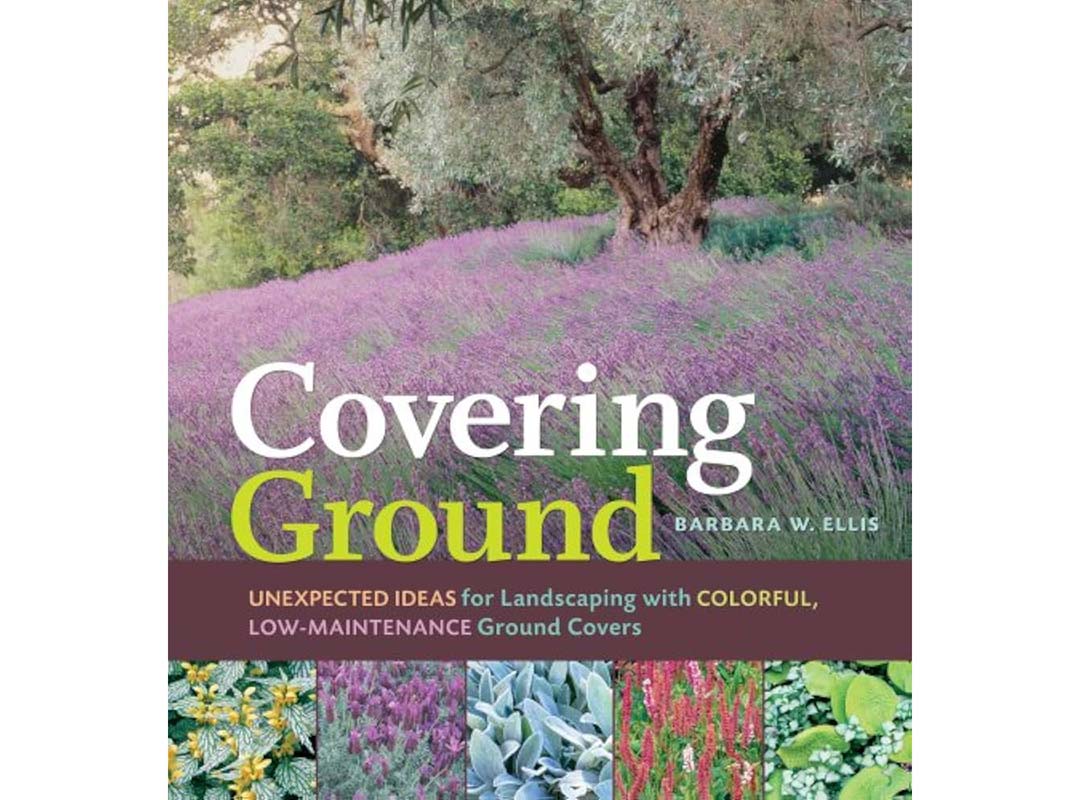
Next up is Covering Ground: Unexpected Ideas for Landscaping with Colorful, Low-maintenance Ground Covers by Barbara W. Ellis. One of many features to appreciate about Covering Ground is that it has many photos and the pictured plants are identified with their scientific name and frequently their common name and variety name. Within each section the descriptions are arranged alphabetically by genus and species, but there are many different sections that cover specific scenarios. This causes some flipping back and forth when a species is mentioned in one context, but the main entry is in a different section. A thorough index helps though. There is a chapter that has suggestions about using mulch or hardscape where even weeds fear to grow. I think this book might be my favorite if I could only read one, but luckily there’s no need to limit your reading since we have all these books at the Knox County Public Library.
Another book you might refer to is The Complete Book of Ground Covers by Gary Lewis. Most of the book is made up of profiles of species that can be used as groundcovers arranged by scientific name. These are in-depth including the Family name, where the species are native, and usually indications of whether each can accept foot traffic, among much other information. The early part of the book contains general information about how to use groundcover plants and several lists of species for special interests such as edible groundcovers and groundcovers for rain gardens, although those lists are not exhaustive. This book is heavy due to its high-quality photographs on every page and thousands of entries, but it is a superb reference. Its photos are also well-identified.
The most recent book I will mention is Groundcover Revolution: How to Use Sustainable, Low-maintenance, Low-water Groundcovers to Replace Your Turf by Kathy Jentz. In contrast to Lewis, Jentz intentionally limits her palette to about 40 core species, although she refers briefly to many more. Starting on page 42 there is a chart that evaluates each featured species across 19 selection criteria, such as which continent it is native to, sun preference, and hardiness. Many of the photos in other chapters do not identify the plants pictured unfortunately, but there are two photos for each featured species in chapter 5, Groundcover Profiles’. Chapter 6 is extremely short, but mentions siting paths, storage, and other uses in places in extra inhospitable spots.
I should disclose that my yard is a balance of what I know to be good for the environment, the neighborhood expectations, and my limited energy. Really, most or all of my lawn should be replaced by something else, but I mow what grows there high and the minimum number of times, and I don’t do anything to make it grow faster such as watering or fertilizing. Mostly I enjoy seeing the different species work together to resist erosion and slow run-off, but for many years I noticed there was one species of grass that seemed to grow faster than the rest in a few little clumps, usually leading to mowing oftener than I liked. But I just silently complained, “Why does it have to be so coarse and tall?” sometimes even forgetting to be thankful that it grew in maple shade where many things don’t grow. So, this year I finally decided to identify it so that I could pick something else that has the same niche. It’s coarse tall fescue, of course. Since it’s not native here, hopefully I can replace it with something that is. Whatever the scale of the improvements you can make, every little bit can help your yard be more useful and enjoyable.
Mountain gorillas rebounded to about 1,000 but still face habitat loss, poaching, disease, and need constant protection.

Library life never stands still, but friendly staff and constant change keep the community thriving together.

Knox County celebrates Black history through education, remembrance, music, and community events.